Last updated on February 10th, 2026 at 09:14 pm
Science estimates that the Earth is 4.6 billion years old. The Fleurieu has some on the oldest rock formations which date back to the Precambrian super interval of time which represents 88% of Earth’s time scale. The geology from this time includes the Paleoproterozoic period in the Proterozoic eon.
The eon is the broadest category of geological time. Earth’s history is characterized by four eons; in order from oldest to youngest, these are the Hadeon, Archean, Proterozoic, and Phanerozoic. Collectively, the Hadean, Archean, and Proterozoic are sometimes informally referred to as the “Precambrian.” (The Cambrian period defines the beginning of the Phanerozoic eon; so, all rocks older than the Cambrian are Precambrian in age.) (Digital Atlas of Ancient Life | Geologic time scale).
The table below lists the time scale as represented in rock and material composition in the Fleurieu.
| Geological epochs | Millions of years | Periods | Era | Eon |
| Holocene | 0.01 to present | Quaternary | Cenozoic | Phanerozoic |
| Pleistocene to Holocene | 2.6-0.01 | Quaternary | Cenozoic | Phanerozoic |
| 7 epochs | 66 to 0.01 | Paleogene to Quaternary | Cenozoic | Phanerozoic |
| Late Carboniferous to Early Permian | 329 to 275 | Carboniferous and Permian | Paleozoic | Phanerozoic |
| Early Cambrian | 541 to 522 | Cambrian | Paleozoic | Phanerozoic |
| Neoproterozoic III to Ediacaran | 635 to 541 | Neoproterozoic | N/A | Proterozoic (Precambrian) |
| Cryogenian to Ediacaran | 720 to 538 | Neoproterozoic | N/A | Proterozoic (Precambrian) |
| Cryogenian | 720 to 635 | Neoproterozoic | N/A | Proterozoic (Precambrian) |
| 7 epochs | 2500 to 1600 | Paleoproterozoic to Mesoproterozoic | N/A | Proterozoic (Precambrian) |
The Department for Energy and Mining of the Government of South Australia provides a detailed geologic time scale which can be used to unlock the terminology as well as the plants and animals which existed as a result of conditions of the earth in the ancient past.
Video: A Brief History of Geologic Time
This 13 minute video produced by the highly reputable US Public Broadcast System (PBS) and available on its YouTube channel provides a concise overview of geologic time.
Digital Atlas of Austalia Lithology Layers
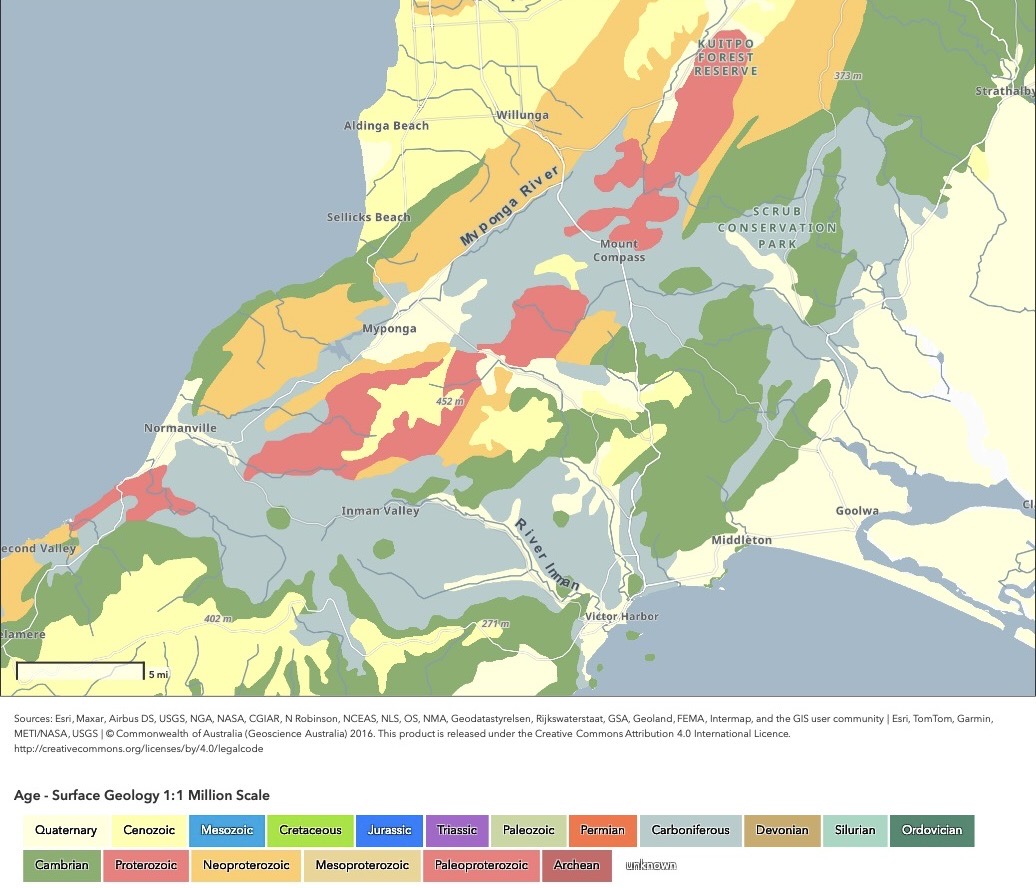
The Digital Atlas of Australia contains a number of lithology (rock type) layers which allow the identification of a rock and material deposits across Australia. Across the Fleurieu, there is a vast variety of rock formations which stretch back in geological time.
Rock formations across the Fleurieu
The table below is a list of the rock and sand formations revealed in the Digital Atlas of Australia Lithology layer. It identifies the geological epoch for each rock formation, and its approximate location on the Fleurieu. It is ordered from the most recent (Halocene) to the most ancient (Precambrian).
| Fleurieu lithology | Geological epochs | Locations |
| Alluvium 38485 | Holocene | Myponga flat plain; Inman Valley river and tributaries; Hindmarsh Tiers road |
| Semaphore Sand Member | Holocene | Part of the Newland Head Conservation Park to the west of Victor Harbor |
| Colluvium 38491 | Quaternary | Borders the intersection of Nangkita and Tookayerta creeks and lies south of Mount Observation |
| Coastal dunes 38488 | Quaternary | Occupies most of the New Headland conservation park |
| Sand plain 38499 | Cenozoic | The flat valley which extends across Seaford, McLaren Vale, Aldinga, and Willunga |
| Sedimentary rocks 72357 | Cenozoic | Runs along Range road near Delamere at the bottom of the Fleurieu; at the tip of the Fleurieu at Cape Jervis; and at an area near Myponga Conservation Park |
| Cape Jervis formation | Late Carboniferous to Early Permian | There are three main distributions of this formation: Inman Valley uplands which stretch from Myponga, Inman Valley heading towards Victor Harbor, and the uplands of Second Valley. A fourth distribution is at coastal Hallett Cove. |
| Normanville Group | Early Cambrian | Runs along the coastal area from Carrickalinga, Myponga Beach forming the uplands south of Sellicks Beach. |
| Keynes Subgroup | Early Cambrian | Runs along the coast at the foot of Cape Jervis; Runs between Mount Magnificent and Ashbourne. |
| Bollaparudda Subgroup | Early Cambrian | Runs along the Deep Creek coast towards Victor Harbor. |
| Encounter Bay Granite | Cambrian | Igneous granite intrusions which appear as islands of the coast at Victor Harbor. |
| Umberatana Group | Cryogenian to Ediacaran | Runs from Second Valley towards Cape Jervis near Delamere; Another distribution occurs as uplands between Hallett Cove, Adelaide Plains and Aberfoyle Park. |
| Burra Group | Cryogenian | Runs north from Myponga along the ridge reaching Echunga and parts north as well as encompassing the area around and north of Clarendon |
| Wilpena Group | Neoproterozoic III to Ediacaran | Runs north west as part of the uplands above the flatlands which make up Sellicks Beach and Willunga. |
| Barossa Complex | Paleoproterozoic to Mesoproterozoic | Reaches north above Mount Compass, Yundi, and stretches across Kyeema Conservation Park. |
Geological history of Hallett Cove
The coastline of Hallett Cove, South Australia features many of the geological features which exist within the Fleurieu in one place. This area has been designated a conservation park because of this significance as well as ancient human artifacts.
Rock formations at Hallett Cove provide outstanding evidence of the late Palaeozoic (280 million years old) glaciation of southern Australia, which has world-wide significance. The smoothed and striated cliff top glacial pavements, discovered by Professor Ralph Tate in 1877, are considered to be the finest of their type and amongst the best in the world. Inland from the glacial pavements on the plateau are crude stone implements attributed to the ancient Kartan culture. This vast Aboriginal camping ground provides important evidence of the first occupants of the Adelaide region, who may have arrived as early as 40,000 years ago. Validated: 6/03/2000 STATEMENT OF GEOLOGICAL SIGNIFICANCE Hallett Cove Conservation Park & Sandison Reserve displays a detailed and exceptionally high quality geological record of South Australia, imparting important insights about the State’s geological history. The Park and Reserve yields evidence of significant glaciations of worldwide significance, recording approximately 645 million years of geological history. It also contains fossiliferous deposits and geologically significant unconformities. Hallett Cove Conservation Park & Sandison Reserve demonstrates four separate periods of glacial activity within one site, a combination that is not seen anywhere else in Australia. Overall, the site’s extensive geological evidence for glaciation is considered among the best in the world. Significant feature include: * striations and cuts within smooth-topped rocks at Black Cliff created by glacier movements approximately 280Ma (Million Years ago), * a glacial lake formed by a 280 million year old glacier where silt deposition has created distinctive multi-coloured layering patterns denoting the depositional environment, * large `erratics’ or `dropstones’, rocks dropped from melting sheets of ice, believed to originate from Encounter Bay, * glacial sediment deposit illustrating ripples and wave patterns that are preserved within the rock. While of a similar age to the other deposits, it demonstrates a higher energy depositional environment. Additionally, the depositional patterns at Hallett Cove Conservation Park & Sandison Reserve infer detailed, cycling changes in sea level, as illustrated by the abundant shelly fossil deposits including both impressions of and physical shellsii at the top of the cliffs surrounding the beach. The sandstone matrix also denotes a warm and shallow environmentiv that was deposited only 3Ma. The area also shows evidence of unconformities, examples of periods of erosion or breaks in deposition in the geological recordv. For example, along Waterfall Creek a missing time period of approximately 320Ma is exposed, while just above it is an example of a missing period from 277Ma, with a third unconformity showing the absence of another 1 million years of sediment. As such, a succession of environmental changes across approximately 600 million years can be seen within the one cliff-face. (SA Heritage | Hallett Cove Conservation Park).
In 2019, Wolfgang Preiss wrote A new geological map of Hallett Cove which was published in the MESA Journal. The article explains how significant the geology is around Hallett Cove citing examples of the rock formations in the Hallett Cove Conservation Park.
Take a tour of Hallett Cove geological tourist spots
https://discoverytrails.sarig.sa.gov.au/story/41
This interactive media presentation reveals the geological highlights which occur in Hallett Cove, which have been incorporated into a boardwalk within the Conservation Park.
References
- Australian Government 2025, Digital Atlas of Australia, viewed on 4 December, 2025, <https://digital.atlas.gov.au>. This is the official website of the Digital Atlas of Australia, a mapping tool for overlaying information from Australian Government datasets.
- Government of South Australia 1993, Hallett Cove Conservation Park & Sandison Reserve [Designated place of geological significance], viewed on 8 February, 2026, <https://maps.sa.gov.au/heritagesearch/HeritageItem.aspx?p_heritageno=4368>. This page provides information about the geological and cultural richness of the Hallett Cove Conservation Park.
- Government of South Australia 2025, Geologic Time Scale, viewed on 28 November, 2025, <https://sarigbasis.pir.sa.gov.au/WebtopEw/ws/plans/sarig1/image/DDD/203866-001>. This 1 page PDF provides a time scale for the geologic time scale which maps eras, periods, and epochs against millions of years and significant evolutionary activity in the plant and animal kingdoms.
- Government of South Australia 2026, Geological Time Scale for Hallett Cove, viewed on 8 February, 2026, <https://sarigbasis.pir.sa.gov.au/WebtopEw/ws/plans/sarig1/image/DDD/205235-021>. This image shows the geological time scale of the rock formations in Hallett Cove, South Australia.
- Government of South Australia 2026, Discovery Trails – Introduction of geology at Hallett Cove, viewed on 8 February, 2026, <https://discoverytrails.sarig.sa.gov.au/story/41>. This page provides a multimedia presentation of the geology at Hallett Cove.
- PBS Eons 2017, A Brief History of Geologic Time, viewed on 28 November, 2025, <https://youtu.be/rWp5ZpJAIAE?si=ZP3vcTTvK78IIym2>. This 13 minute video provides an overview of geologic time. This is the best quick review of geologic time.
- SARIG Catalogue (Government of South Australia) 2024, RB 99/00028 Sand resources of the Mount Compass area. Reconnaissance drilling and testing., viewed on 8 February, 2026, https://catalog.sarig.sa.gov.au/document/rb9900028.
This page provides a link to a report written by geologists: Pain, A.M.;Shaw, R.; Valentine, J.T.. - Preiss, W 2019, New Hallett Cove geological map, viewed on 8 February, 2026, https://www.energymining.sa.gov.au/industry/geological-survey/mesa-journal/previous-feature-articles/new_hallett_cove_geological_map.
This page provides information about the Hallett Cove geology.