Report from Nature Glenelg Trust
Farrington, L., Bachmann, M., Taylor, B. and Roberts, T. (2017) Identifying Fleurieu Peninsula swamps with eco-hydrological restoration potential in the Tookayerta catchment: A targeted assessment of landscape change within the SA Murray Darling Basin NRM Region. Nature Glenelg Trust, Adelaide.
Description
The report from Nature Glenelg Trust provides initially a historical perspective of the agricultural development of the Tookayerta catchment from the 1890s to the current times. It pays homage to the European settlers to came to the region to harness the landscape for agriculture. In the beginning, settlers were only able to establish subsistence farming. Agricultural research resources between the 1920s and 40s were applied firstly to drain the peatlands to yield productive and then secondly to turn the ‘sandy desert’ lands to pasture for dairy and beef production. This led to a substantial loss of both wetland and woodland habitat in the Tookayerta catchment between 1945 and 1980.
The second part of the report focuses on how wetlands along the Tookayerta can be managed on both privately held and public lands to restore the native habitat. This would foster a return of unique plant life which, in turn, can provide a protected habitat for threatened fauna.
For more details, read the Executive Summary of this report.
Parts, chapters and sections
Executive summary p. 2
Contents p. 5
1 Introduction p. 6
1.1 Project objective p. 6
1.2 Requirements p. 7
1.3 Project deliverables p. 7
1.4 Project context p. 7
1.5 Consultation p. 7
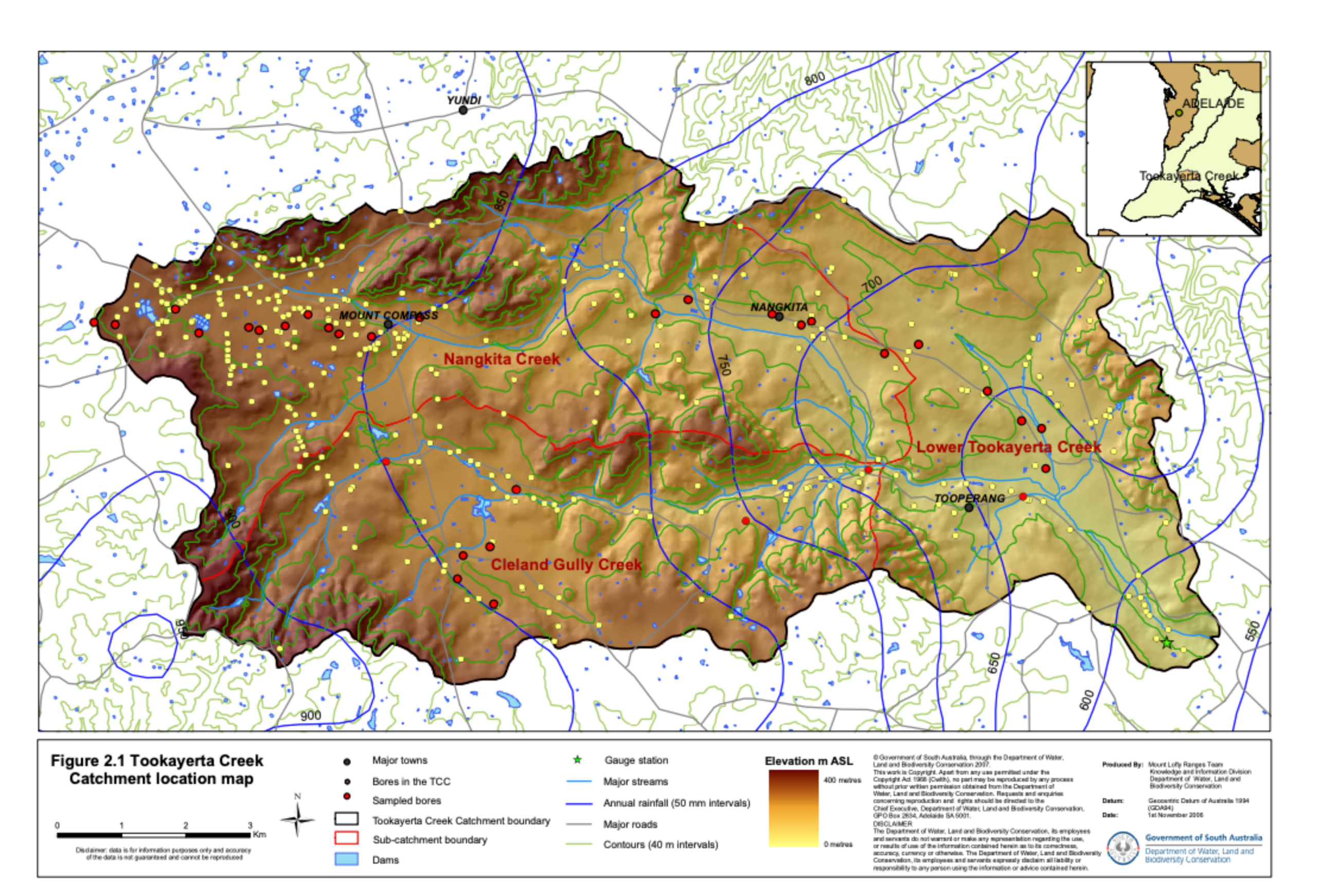
2 Site description p. 9
2.1 Climatic context p. 12
3 Early catchment history and development p. 12
3.1 Catchment history prior to the 1890s p. 13
3.2 Catchment history from 1890 to 1945 p. 19
3.3 The impact of past development patterns on present land use p. 27
4 Contemporary catchment changes and trends p. 28
4.1 Modern (post-1945) changes in regional and catchment vegetation cover p. 28
4.2 Changes in catchment hydrology p. 32
4.2.1 Drainage p. 32
4.2.2 Dams and direct stream extraction p. 36
4.2.3 Groundwater wells p. 38
4.3 Changes in catchment land use p. 42
4.4 Conservation values p. 43
4.4.1 Swamp recovery p. 43
4.4.2 Significant fauna p. 44
4.4.3 Aquatic fauna p. 47
4.4.4 Significant flora p. 48
4.5 Biological threats and disturbances p. 49
4.5.1 Stock grazing and trampling p. 49
4.5.2 Weeds of significance p. 50
4.6 Cumulative impact of changes on wetlands p. 50
5 Considerations in determining a restoration approach p. 53
6 Landscape assessment and prioritisation p. 59
6.1 Introduction to the landscape assessment analysis p. 59
6.2 Parameters and metrics used in the landscape assessment p. 59
6.3 Results of the landscape assessment p. 61
6.4 Initial priorities p. 65
7 Summary p. 66
8 References p. 69
Appendices p. 74
Appendix 1: Artificial drainage by period of construction p. 74
Appendix 2: Threatened fauna recorded from the Tookayerta catchment p. 77
Appendix 3: Threatened flora recorded from the Tookayerta catchment p. 78
Appendix 4: Wetland scores from the landscape assessment & prioritisation process p. 81
About the Authors
Ben Taylor
Ben has been working on wetland conservation, restoration, monitoring and management issues since 2004, across the government, private and NGO sectors. He has worked extensively in the South East of SA, preparing the Lower South East wetland inventory in 2006, and contributing to several wetland restoration projects in the region since that time. He has also worked closely with Aboriginal communities of the lower River Murray, Lower Lakes, Coorong and South East regions on a number of wetland restoration projects. Recently Ben has been focussed on restoration of the critically endangered Fleurieu Peninsula Swamps ecological community and on saltmarsh restoration in Port Phillip Bay.
Mr Mark Bachmann
Mark has extensive knowledge of south-eastern Australian ecosystem ecology, threatening processes and prioritisation of on-ground works. He has a particular passion for small mammal ecology, private land conservation, wetland restoration, and the design / implementation of novel conservation programs. Mark has worked in the region since 1996, including management and delivery of on-ground, research and education based ecological programs.
Dr Lachlan Farrington
Lachlan has a research background in landscape genetics, and since 2007 has developed specialised applied ecological experience with a range of technical tools (GIS, remote sensing, data-logger and field ecological data interpretation, etc.) to deliver science-based, on-ground environmental outcomes. In 2022 he was appointed to a key scientific leadership role in NGT as our Principal Ecologist. Lachlan has extensive experience in NRM planning, field and technical ecological studies and group facilitation, enabling him to lead complex wetland restoration projects, eco-hydrological investigations and landscape planning tasks.
Ms Tessa Roberts
Tessa started her journey into wetlands whilst researching reeds (Phragmites australis) in Black Swamp on the Fleurieu Peninsula during her honours degree. She has experience working on environmental projects for several other NGOs, and has skills including native seed collection, plant ID, GIS/mapping, report writing, and science communication. At NGT Tessa works on wetland restoration and ecology projects, including Fleurieu Peninsula Swamps. She has prior experience in Graphic Design, and also edits the NGT monthly newsletter. Tessa is passionate about conservation and environmental restoration in all ecosystems.
(Nature Glenelg Trust | Our People)
Where to find
A digital copy is available as a PDF at: Nature Glenelg Trust: Identifying Fleurieu Peninsula swamps with eco-hydrological restoration potential in the Tookayerta catchment.
References
- Farrington, L, Bachmann, M, Taylor, B, Roberts, T 2017, Identifying Fleurieu Peninsula swamps with eco-hydrological restoration potential in the Tookayerta catchment, viewed on 26 September, 2026, <https://natureglenelg.org.au/wp-content/uploads/2017/08/NGT-Tookayerta-Catchment-Assessment-FINAL-for-website-23-08-2017.pdf>. This 86 page PDF published by Nature Glenelg Trust provides deep insights into the level of effort to restore the Tookayerta catchments, one of the significant ecosystems on the Eastern Mount Lofty drainage systems which flow into the Murray Darling.
- 2007, E, Zulfic, D, Love, A DWLBC REPORT Groundwater Recharge Investigation in the Tookayerta Creek, Catchment, South Australia, viewed on 26 September, 2026, <https://www.waterconnect.sa.gov.au/Content/Publications/DEW/ki_dwlbc_report_2007_14.pdf>. This 44 page PDF is a report on groundwater recharge for the Tookayerta Creek for the Department of Water, South Australia.