Research
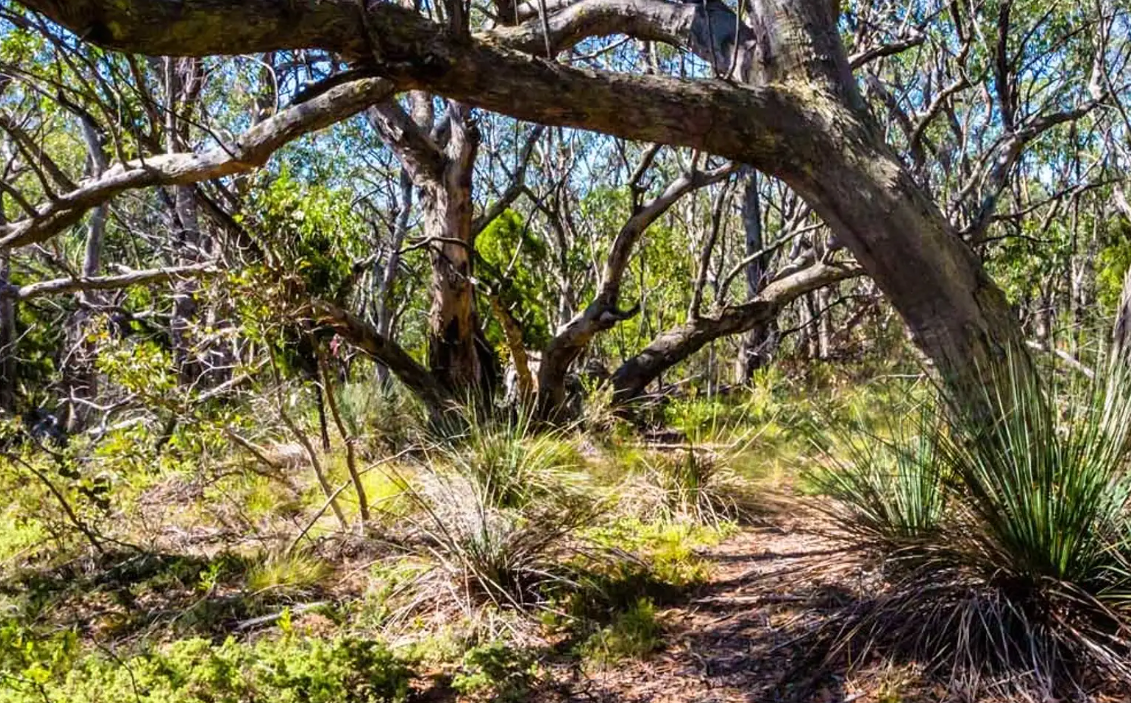
Kyeema Conservation Park is located on the Fleurieu Peninsula and spans over 347 hectares. Walking along the trails you will notice an overstorey of mainly messmate stringy bark (Eucalyptus obliqua), with some pink gum (E. fasciculosa) and cup gum (E. cosmophylla), partnered with a thick and diverse under storey.
National Parks and Wildlife Service (SA) | Kyeema Conservation Park
Location
Kyeema Conservation Park is located between Mount Compass and Ashbourne, south of Adelaide in the southern Mount Lofty Ranges. The park is managed by the National Parks and Wildlife Service, a branch of the Department of Environment and Water, Government of South Australia.
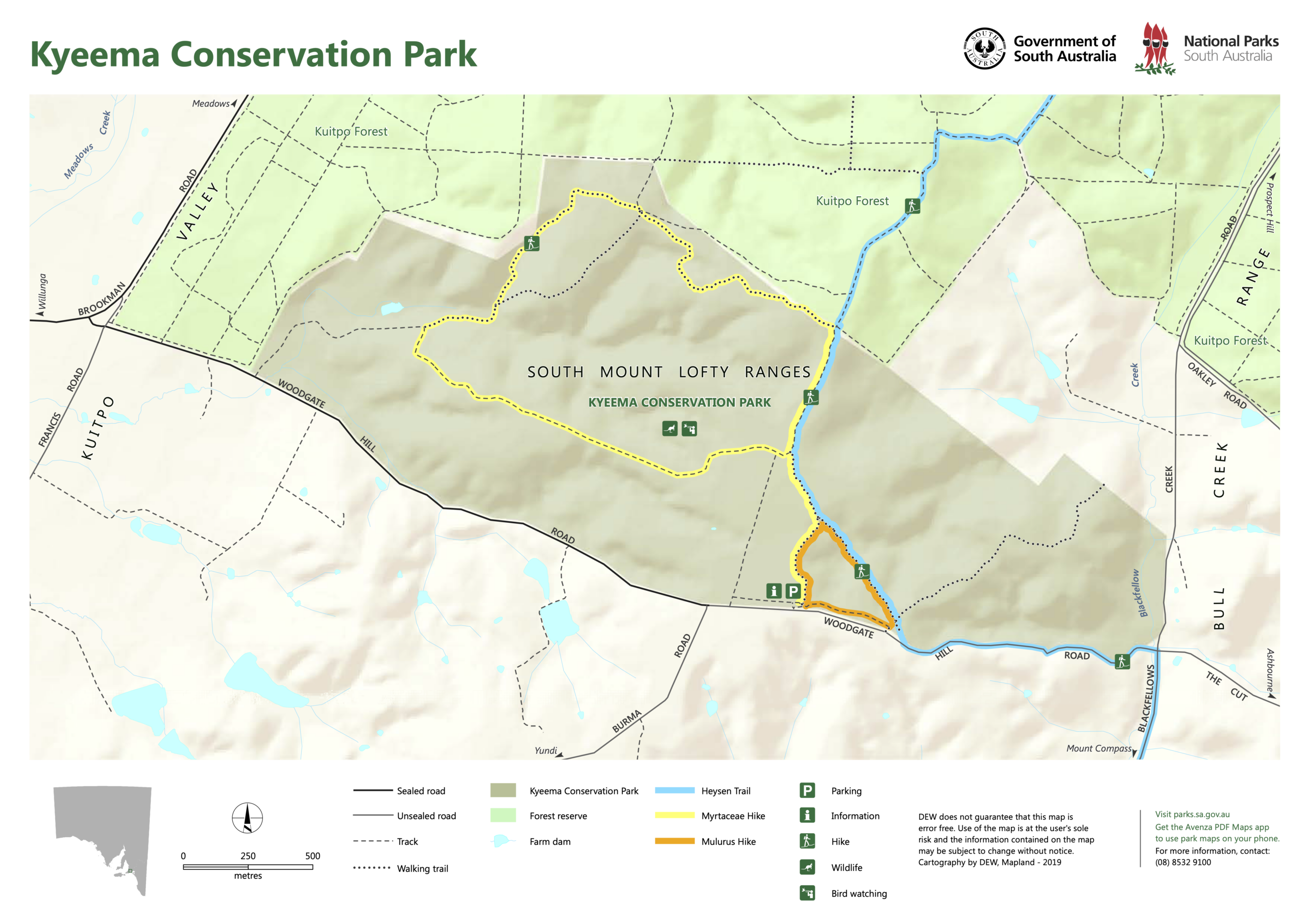
This map is available as a PDF from the Kyeema Conservation Park online page.
National Parks and Wildlife Service South Australia | Map: Kyeema Conservation Park
Geology/Lithology
The geology which laid down the rock formation occurred within the Paleoproterozoic to Mesoproterozoic eras between 2500 to 1600 million years ago. The rock type is referred to as the Barossa Complex. Kyeema Conservation Park is part of a larger area of Barossa Complex which starts north above Mount Compass and Yundi, encompassing Kyeema and the conservation park.
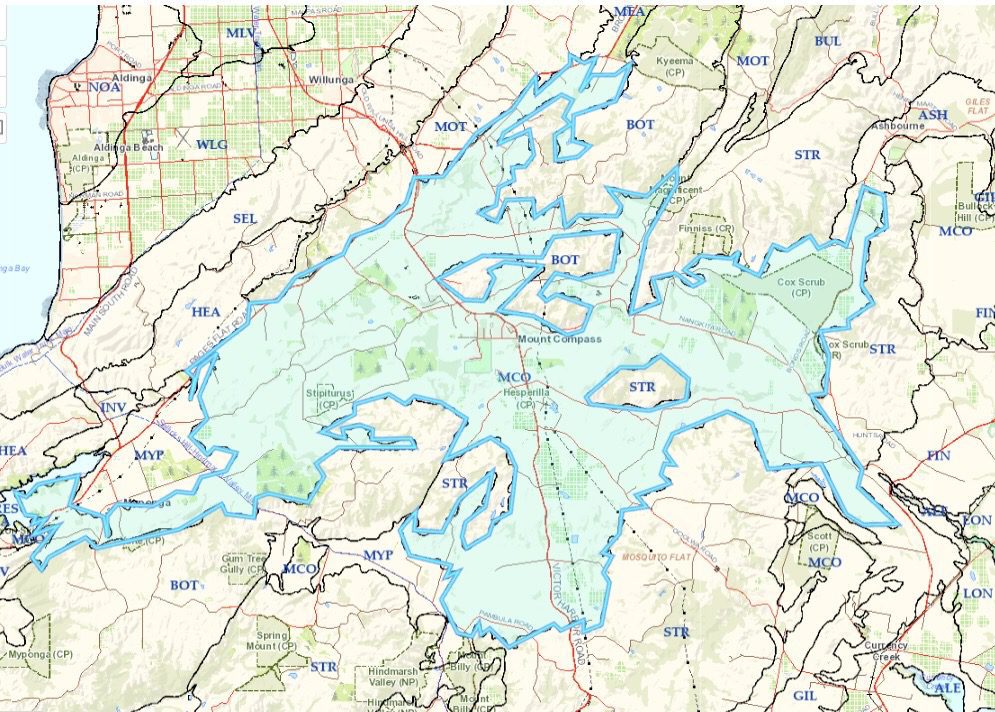
The image below shows the distribution of Barossa complex which stretches north of Mount Compass on a diagonal angle towards Kuitpo. The underlying geology and rock type (lithology) is defined using the Atlas of Australia: Lithology layer, an online tool provided by the Australian Government: GeoScience agency.
Metamorphic rocks with retrograde metamorphism; metasediments, strongly banded parallel to gneissic foliation; minor intrusive granitic, pegmatitic and amphibolitic dykes.
The Atlas of Australia | Lithology: Barossa Complex
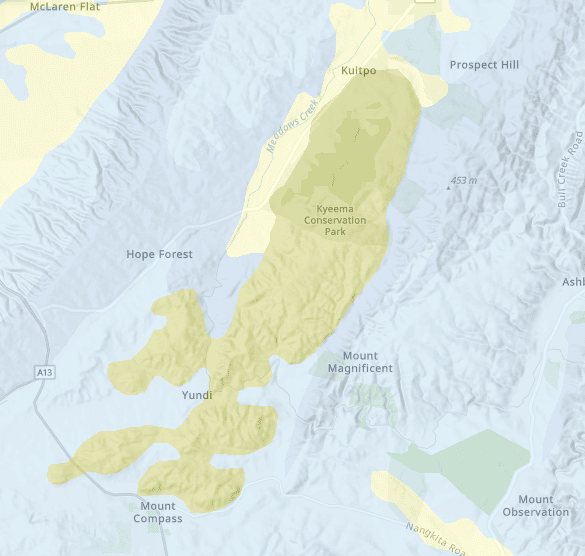
Atlas of Australia: Lithology layer | Barossa Complex
Topography
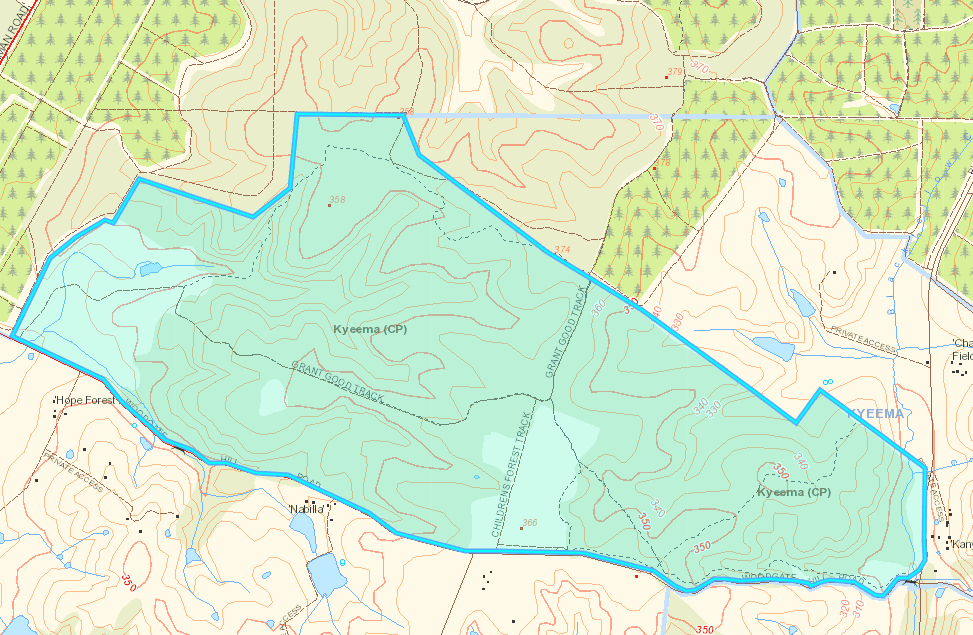
Kyeema Conservation Park is located on a hill which reaches over 360 metres in elevation in the centre of the park. When precipitation falls on the park, it drains on the north-western side to Meadows Creek and to Blackfellows Creek on the south-east side. Both creeks are tributaries of the Finniss River, which drains into the Murray-Darling catchment.
Soils
The soils which lie beneath the woodland community is defined by the soil landscape BOT (Bob Tiers Land System).
Government of South Australia | Bob Tiers Land System
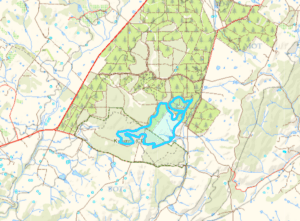
NatureMaps: Soils | Mount Compass (BOTAeC)
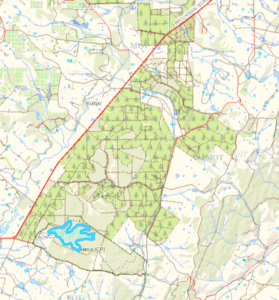
NatureMaps: Soils | Mount Compass (BOTAeD)
The majority of the soils are sandy loam surfaced texture contrast soils with friable brown to red clayey subsoils forming in freshly weathered or kaolinitic weathered basement rock. There are shallow stony soils on steeper rocky slopes, and sandy loam ironstone soils on flat topped crests. Deep sandy loam texture contrast soils dominate valley flats, associated with deep gradational sandy loams and dark clay loams.
Rolling to very steep low hills and hills formed on schists of the Barossa Complex. Surface rock and stone are variable, with very rocky patches occurring most commonly on steepest slopes.
- AeC: Rolling low hills with minor to moderate rock and stone, and well defined, narrow drainage depressions; relief is up to 100 m and slopes are 18-30%.
- AeD: Steep to very steep and very rocky hillslopes with very narrow crests and drainage depressions; relief is up to 175 m and slopes are 30-80%.
Most soils have texture contrast profiles with sandy loam surfaces overlying friable clayey subsoils forming in fresh weathering rock. On upper slopes where rocks are deeply weathered and kaolinized, soils are similar but deeper. Shallow stony soils are common on rocky and steep slopes. Deeper texture contrast and stony soils on local alluvium and colluvium occur on lower slopes and drainage depressions.
Main soils: Acidic sandy loam over brown clay on schist – K4a (E) on hillslopes
Acidic sandy loam over brown clay on kaolinized schist – K4b (L) on upper slopes
- Shallow stony sandy loam – L1 (E) on steeper rocky slopes
- Sandy loam over brown or red clay – F1c (L) on deeply weathered rock on lower slopes
- Sandy loam over brown mottled clay – F1a (M) in drainage depressions
- Gradational red loamy sand – M1a (M) in drainage depressions
Government of South Australia | Bob Tiers Land System
Agricultural potential
The main soils are moderately deep and moderately to well drained. Inherent fertility is relatively low, and soils are highly susceptible to acidification. The land is too steep for uses involving regular cultivation, but there is some potential for perennial horticultural and floricultural crops where water is available.
Government of South Australia | Bob Tiers Land System
Plant Communities
There are five plant communities indentified in NatureMaps within the Kyeema Conservation Park boundaries:
- Messmate Stringybark (Eucalyptus obliqua) open forest (ML0101PE)
- Messmate Stringybark (Eucalyptus obliqua) + Brown Stringybark (Eucalyptus baxteri) Open Forest (ML0201PE)
- Brown Stringybark (Eucalyptus baxteri) + Pink Gum (Eucalyptus fasciculosa) + Cup Gum (Eucalyptus cosmophylla) Low Woodland (ML0404PE)
- Messmate Stringybark (Eucalyptus obliqua) over Pink Gum(Eucalyptus fasciculosa) Open Forest over sclerophyll shrubs (ML0801PE)
- Red gum (Eucalyptus camaldulensis var. camaldulensis) woodland (AP0005PE)
Kyeema Conservation Park plant communities
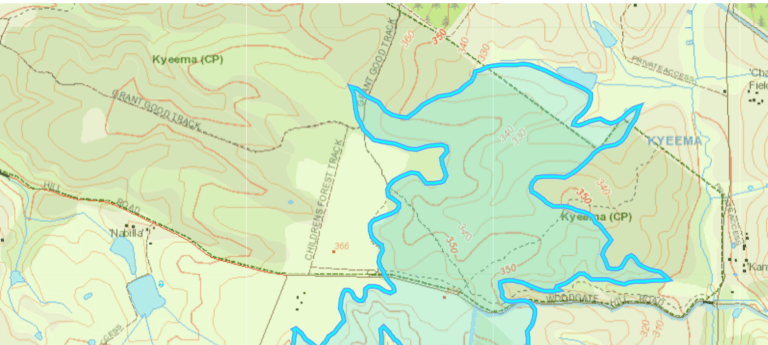
Messmate Stringybark (Eucalyptus obliqua) open forest occupies the central part of the park occupies the highlands sloping towards Blackfellows creek.
Plant community ID: ML0101PE
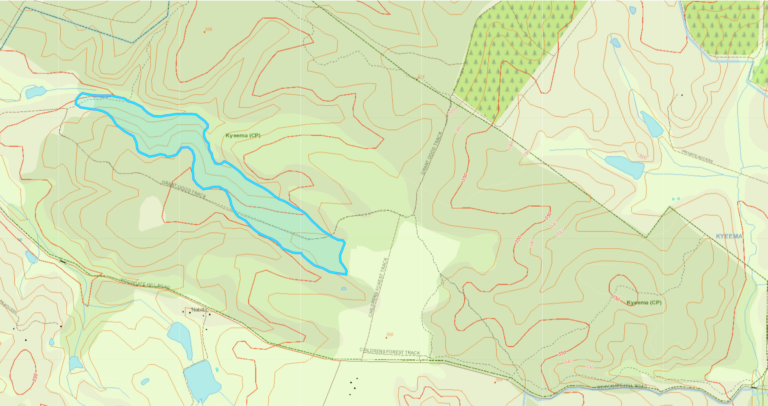
Messmate Stringybark (Eucalyptus obliqua) + Brown Stringybark (Eucalyptus baxteri) open forest occupies the sloping land which drains to the northwest into Meadows creek.
Plant community ID: ML0201PE
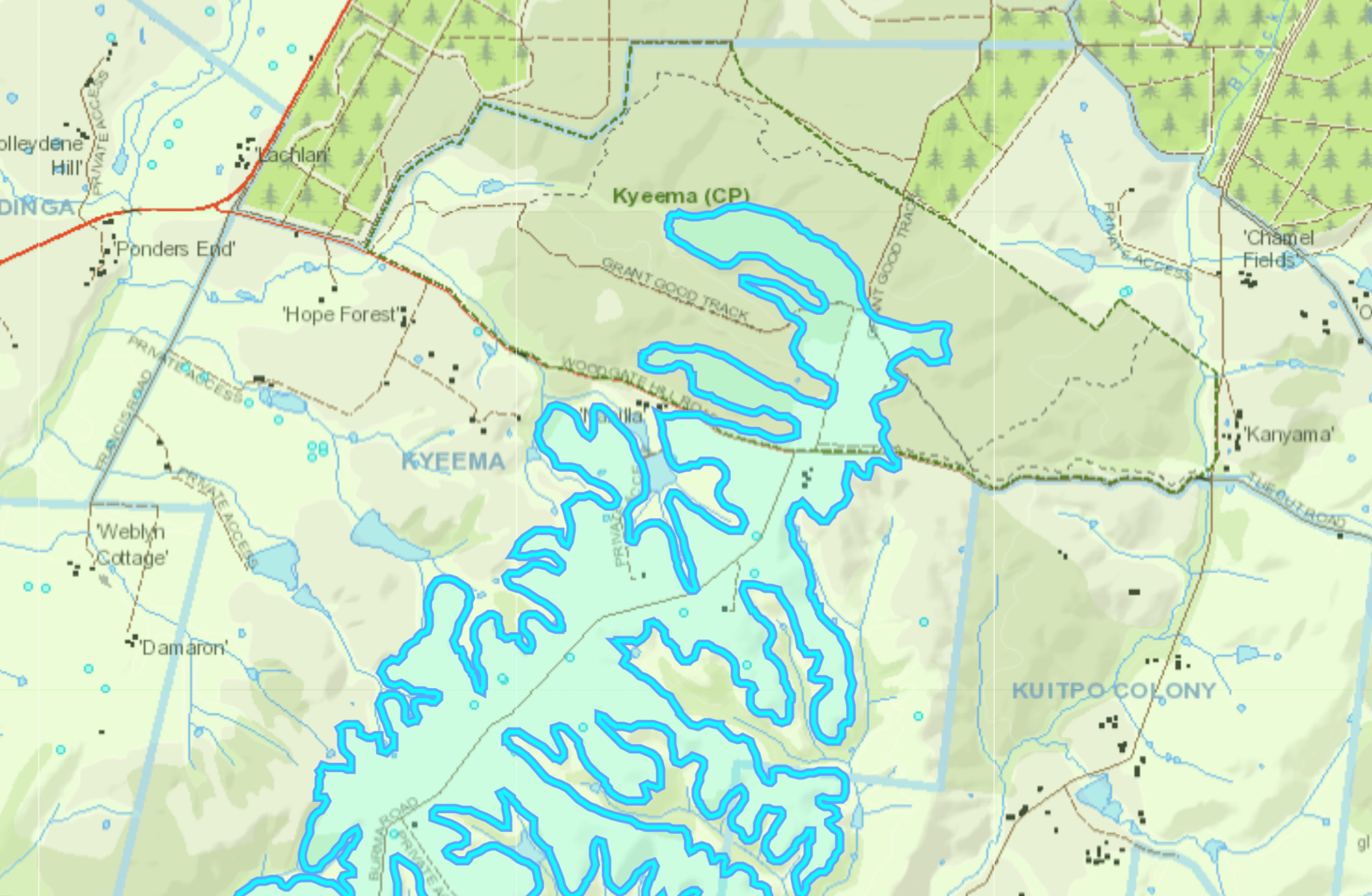
Brown Stringybark (Eucalyptus baxteri) + Pink Gum (Eucalyptus fasciculosa) + Cup Gum (Eucalyptus cosmophylla) low woodland occupies the highest elevation areas which are greater than 350 metres.
Plant community ID: ML0404PE
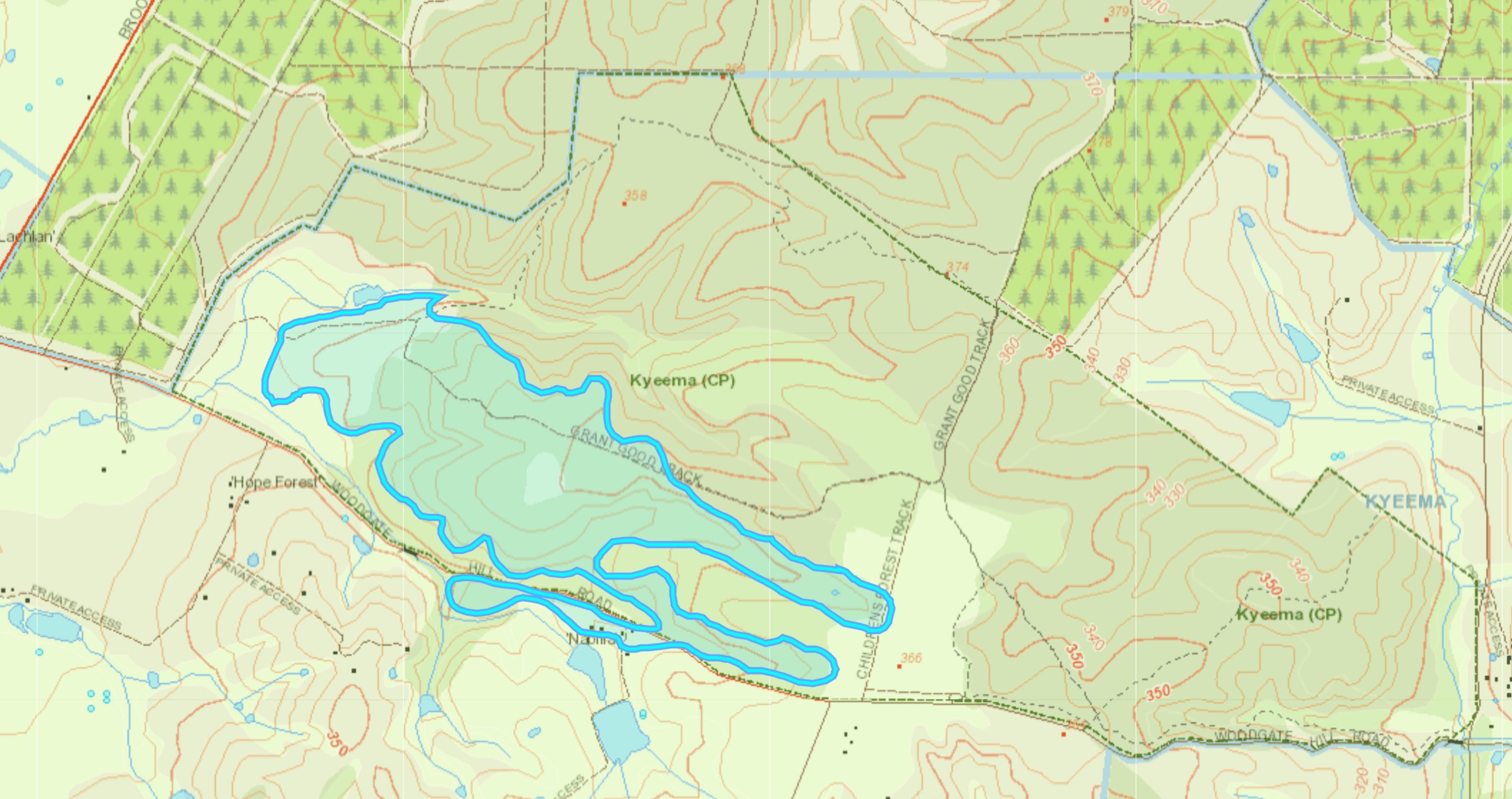
Messmate Stringybark (Eucalyptus obliqua) over Pink Gum(Eucalyptus fasciculosa) Open Forest over sclerophyll shrubs occupies the downhill slope on the southwestern side of a hill.
Plant community ID: ML0801PE
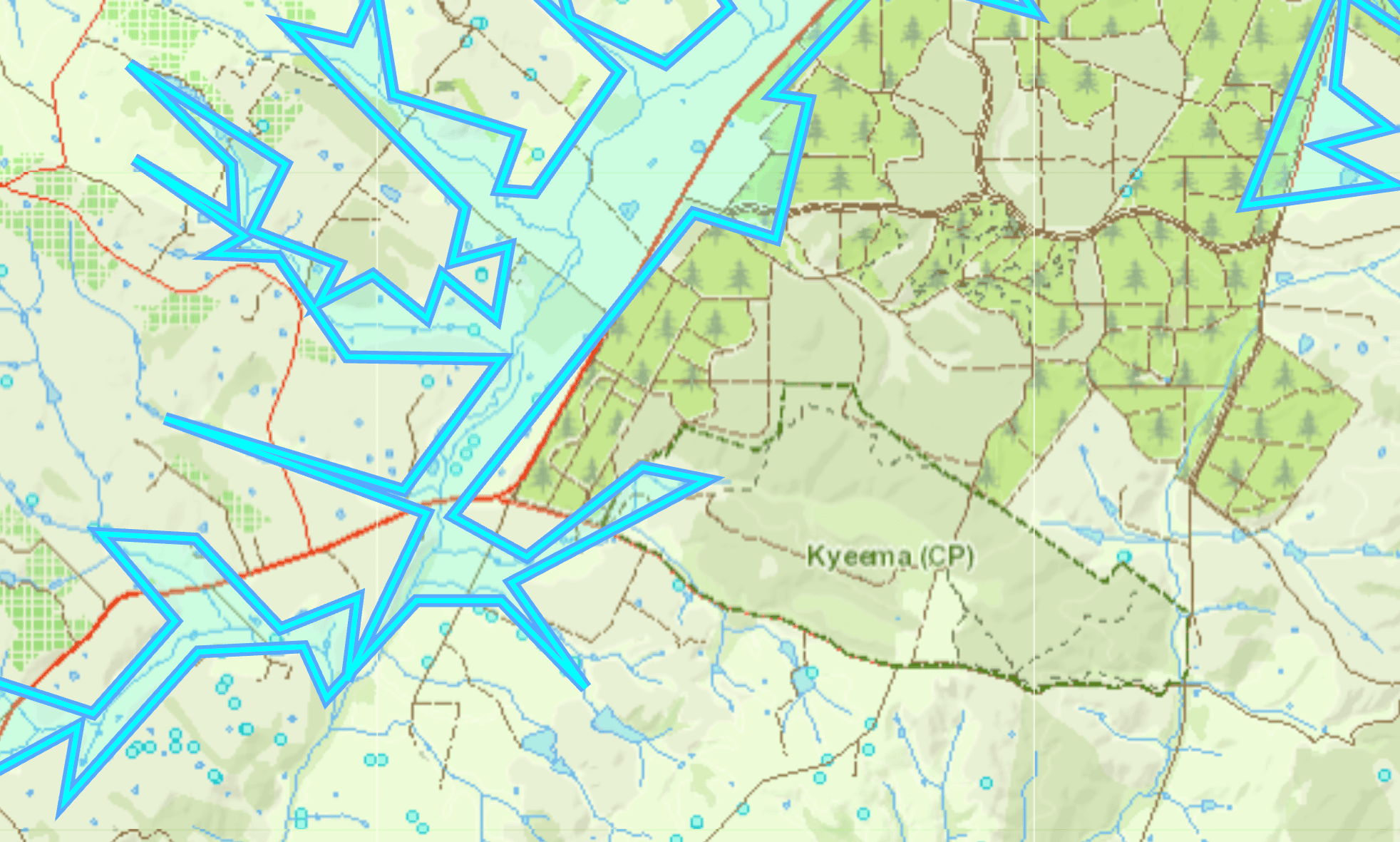
Red gum (Eucalyptus camaldulensis var. camaldulensis) woodland occupies the lowlands which drain into Meadows creek. The Red gum woodland occupied the Meadows creek lowlands and its tributaries.
Plant community ID: AP0005PE
Fauna observed through NatureMaps
Using NatureMaps, it is possible to generate a table of fauna which have been observed in the Kyeema Conservation Park observation records. The dataset is specific to Kyeema Conservation Park, containing almost 130 observations since 1969 to 2025.
- NSXCODE. Unique code for each taxonomic entity (species name) in the database, used to allow record taxonomy to be updated as changes occur.
- Fauna SPECIES code. Generated from a combination of the first two letters of the dataset (e.g. SU = Survey), the first letter of the taxon group (e.g. A=Amphibia, B=Birds, F = Fish, I = Invertebrates, M = Mammalia and R = Reptilia)
- CLASS NAME. Taxonomic class to which the species belongs, related to the field named CLASSNR. Class Names: ‘AMPHIBIA’=Amphibians, ‘AVES’=Birds, ‘PETROMYZONTI’=Lampreys, ‘MAMMALIA’=Mammals, ‘ACTINOPTERI’=Fish, ‘REPTILIA’=Reptiles, ‘CHONDRICHTHYES’=Sharks & Rays, ‘MYXINI’=Hagfish, ‘INVERTEBRATES’=Invertebrates
- SPECIES. This is the scientific name for the native animal.
- COMMON NAME. This is the common name of the native animal.
- NATIVE (Y/N). Y=Yes and indicates that the plant is indigenously native to the conservation park.
- FEDERAL RATING. National conservation rating of the species based on the Environmental Protection and Biodiversity Conservation Act 1999. VU = Vulnerable, EN = Endangered, CR = Critically Endangered, EX = Extinct, CD = Conservation. Dependent. Endangered Species Status Code is based on the Environmental Protection and Biodiversity Conservation Act 1999.
- SA RATING. South Australian conservation rating of the species based on the National Parks and Wildlife Act 1972. R = Rare, V = Vulnerable, E = Endangered.
- RECORD indicates the number of sightings made for the given species.
- DATE indicates the last date the species was observed in this dataset. Date format has been altered from DD-MMM-YYYY to YYYY-MM-DD so that it is possible to filter dates from latest to oldest observation.
| NSXCODE | SPECIES | CLASS | SPECIES | COMMON NAME | NATIVE | NATIONAL RATING | STATE RATING | NUMBER OF RECORDS | DATE OF LAST RECORD |
|---|---|---|---|---|---|---|---|---|---|
| E03134 | A | AMPHIBIA | Crinia signifera | Clicking Froglet | Y | 4 | 2016-07-23 | ||
| M03058 | A | AMPHIBIA | Limnodynastes dumerilii | Eastern Banjo Frog | Y | 2 | 2000-02-28 | ||
| G03063 | A | AMPHIBIA | Limnodynastes tasmaniensis | Spotted Marsh Frog | Y | 1 | 1978-05-01 | ||
| C03117 | A | AMPHIBIA | Pseudophryne bibronii | Brown Broodfrog | Y | R | 2 | 2020-04-20 | |
| G06815 | A | AMPHIBIA | Rawlinsonia calliscelis | South Australian Tree Frog | Y | 1 | 1978-05-01 | ||
| E00486 | B | AVES | Acanthiza chrysorrhoa | Yellow-rumped Thornbill | Y | 5 | 2018-05-30 | ||
| M21142 | B | AVES | Acanthiza chrysorrhoa leighi | Yellow-rumped Thornbill (eastern SA) | Y | 1 | 2015-12-12 | ||
| M00470 | B | AVES | Acanthiza lineata | Striated Thornbill | Y | ssp | 9 | 2018-08-19 | |
| K21053 | B | AVES | Acanthiza lineata clelandi | Striated Thornbill (MLR, SE) | Y | 24 | 2024-11-03 | ||
| Z00471 | B | AVES | Acanthiza nana | Yellow Thornbill | Y | 1 | 1998-06-06 | ||
| W00475 | B | AVES | Acanthiza pusilla | Brown Thornbill | Y | 5 | 2018-08-19 | ||
| Z21055 | B | AVES | Acanthiza pusilla samueli | Brown Thornbill (MLR) | Y | 28 | 2024-11-03 | ||
| E04170 | B | AVES | Acanthiza reguloides australis | Buff-rumped Thornbill | Y | 2 | 2000-05-29 | ||
| W04143 | B | AVES | Acanthorhynchus tenuirostris | Eastern Spinebill | Y | 7 | 2018-08-19 | ||
| Q21056 | B | AVES | Acanthorhynchus tenuirostris halmaturinus | Eastern Spinebill (KI, MLR, southern FR) | Y | 15 | 2020-01-27 | ||
| S04125 | B | AVES | Accipiter cirrocephalus cirrocephalus | Collared Sparrowhawk | Y | 1 | 2016-11-26 | ||
| A04152 | B | AVES | Accipiter fasciatus fasciatus | Brown Goshawk | Y | 1 | 2007-11-11 | ||
| W00211 | B | AVES | Anas gracilis gracilis | Grey Teal | Y | 1 | 1991-03-17 | ||
| E04146 | B | AVES | Anas superciliosa | Pacific Black Duck | Y | 2 | 2013-09-27 | ||
| W04127 | B | AVES | Anthochaera carunculata | Red Wattlebird | Y | 19 | 2020-01-06 | ||
| Z21071 | B | AVES | Anthochaera carunculata woodwardi | Red Wattlebird (MLR, AP, YP, EP, far west, Yellabinna) | Y | 1 | 2015-12-12 | ||
| G00647 | B | AVES | Anthus australis | Australian Pipit | Y | 1 | 1978-05-01 | ||
| G04139 | B | AVES | Aquila audax audax | Wedge-tailed Eagle | Y | 4 | 2001-09-20 | ||
| W00547 | B | AVES | Artamus cyanopterus | Dusky Woodswallow | Y | 2 | 2019-08-17 | ||
| Q04176 | B | AVES | Cacatua galerita | Sulphur-crested Cockatoo | Y | 6 | 2019-12-09 | ||
| W00271 | B | AVES | Cacatua sanguinea gymnopis | Little Corella | Y | 1 | 1978-05-01 | ||
| S04141 | B | AVES | Cacomantis flabelliformis flabelliformis | Fan-tailed Cuckoo | Y | 7 | 2019-10-15 | ||
| C00337 | B | AVES | Cacomantis pallidus | Pallid Cuckoo | Y | 1 | 2018-04-13 | ||
| M00614 | B | AVES | Caligavis chrysops | Yellow-faced Honeyeater | Y | 4 | 2017-10-08 | ||
| U21074 | B | AVES | Caligavis chrysops samueli | Yellow-faced Honeyeater (MLR, southern FR) | Y | 15 | 2020-01-27 | ||
| U00342 | B | AVES | Chalcites basalis | Horsfield’s Bronze Cuckoo | Y | 3 | 2017-10-08 | ||
| A00344 | B | AVES | Chalcites lucidus plagosus | Shining Bronze Cuckoo | Y | 5 | 2019-10-15 | ||
| U00202 | B | AVES | Chenonetta jubata | Maned Duck | Y | 3 | 2013-09-27 | ||
| G04171 | B | AVES | Climacteris picumnus picumnus | Brown Treecreeper | Y | 1 | 2016-11-26 | ||
| A00408 | B | AVES | Colluricincla harmonica | Grey Shrikethrush | Y | 34 | 2024-11-03 | ||
| A21148 | B | AVES | Colluricincla harmonica harmonica | Grey Shrikethrush (eastern SA) | Y | 2 | 2017-09-21 | ||
| Y04120 | B | AVES | Coracina novaehollandiae | Black-faced Cuckooshrike | Y | 4 | 2013-09-27 | ||
| S00693 | B | AVES | Corcorax melanorhamphos | White-winged Chough | Y | R | 3 | 2018-05-30 | |
| Y04172 | B | AVES | Cormobates leucophaea | White-throated Treecreeper | Y | 7 | 2018-05-30 | ||
| C21077 | B | AVES | Cormobates leucophaea grisescens | White-throated Treecreeper (MLR) | Y | 31 | 2024-11-03 | ||
| E00954 | B | AVES | Corvus mellori | Little Raven | Y | 29 | 2024-07-28 | ||
| E10334 | B | AVES | Corvus sp. | Ravens, Crows | Y | 1 | 2017-03-31 | ||
| M00322 | B | AVES | Dacelo novaeguineae novaeguineae | Laughing Kookaburra | Y | 13 | 2020-01-06 | ||
| C00549 | B | AVES | Daphoenositta chrysoptera pileata | Black-capped Sittella | Y | 1 | 2024-07-28 | ||
| U04150 | B | AVES | Dicaeum hirundinaceum hirundinaceum | Mistletoebird | Y | 2 | 2020-01-06 | ||
| G04199 | B | AVES | Egretta novaehollandiae | White-faced Heron | Y | 3 | 2007-11-11 | ||
| C00273 | B | AVES | Eolophus roseicapilla | Galah | Y | 23 | 2020-01-06 | ||
| Q21152 | B | AVES | Eolophus roseicapilla albiceps | Galah (most of SA) | Y | 2 | 2017-09-21 | ||
| C04129 | B | AVES | Falco cenchroides cenchroides | Nankeen Kestrel | Y | 1 | 2007-11-11 | ||
| Z00235 | B | AVES | Falco longipennis murchisonianus | Australian Hobby | Y | 3 | 2001-09-20 | ||
| K04181 | B | AVES | Falcunculus frontatus frontatus | Eastern Shriketit | Y | R | 2 | 1993-10-19 | |
| E00258 | B | AVES | Glossopsitta concinna | Musk Lorikeet | Y | 4 | 2020-01-27 | ||
| W00415 | B | AVES | Grallina cyanoleuca cyanoleuca | Magpielark | Y | 8 | 2019-10-28 | ||
| S00705 | B | AVES | Gymnorhina tibicen | Australian Magpie | Y | 31 | 2020-01-27 | ||
| Q00228 | B | AVES | Haliastur sphenurus | Whistling Kite | Y | 1 | 2015-12-12 | ||
| K00357 | B | AVES | Hirundo neoxena neoxena | Welcome Swallow | Y | 7 | 2019-12-09 | ||
| K04369 | B | AVES | Hylacola pyrrhopygia parkeri | Chestnut-rumped Heathwren (Mount Lofty Ranges) | Y | EN | E | 2 | 2019-08-17 |
| S00529 | B | AVES | Malurus cyaneus | Superb Fairywren | Y | 11 | 2018-08-19 | ||
| W21103 | B | AVES | Malurus cyaneus leggei | Superb Fairywren (Mainland SA) | Y | 23 | 2024-07-28 | ||
| G00583 | B | AVES | Melithreptus brevirostris | Brown-headed Honeyeater | Y | ssp | 14 | 2020-01-06 | |
| A21104 | B | AVES | Melithreptus brevirostris brevirostris | Brown-headed Honeyeater (lower SE) | Y | 3 | 2018-04-13 | ||
| E21106 | B | AVES | Melithreptus brevirostris pallidiceps | Brown-headed Honeyeater (MLR, MM) | Y | 1 | 2015-12-12 | ||
| A00580 | B | AVES | Melithreptus gularis | Black-chinned Honeyeater | Y | ssp | 1 | 2001-05-12 | |
| S04133 | B | AVES | Melithreptus lunatus | White-naped Honeyeater | Y | 9 | 2019-12-09 | ||
| C04137 | B | AVES | Microcarbo melanoleucos melanoleucos | Little Pied Cormorant | Y | 3 | 1998-06-06 | ||
| G04075 | B | AVES | Neochmia temporalis temporalis | Red-browed Finch | Y | 7 | 2018-05-30 | ||
| Z00307 | B | AVES | Neophema elegans elegans | Elegant Parrot | Y | R | 14 | 2020-10-09 | |
| M00242 | B | AVES | Ninox boobook | Australian Boobook | Y | 2 | 2019-08-17 | ||
| W00043 | B | AVES | Ocyphaps lophotes lophotes | Crested Pigeon | Y | 1 | 1991-03-17 | ||
| E09418 | B | AVES | Pachycephala fuliginosa fuliginosa | Western Whistler | Y | 33 | 2020-01-27 | ||
| G09419 | B | AVES | Pachycephala pectoralis youngi | Australian Golden Whistler | Y | 2 | 2024-11-03 | ||
| K00401 | B | AVES | Pachycephala rufiventris rufiventris | Rufous Whistler | Y | 3 | 2017-10-08 | ||
| G04227 | B | AVES | Pardalotus punctatus | Spotted Pardalote | Y | 2 | 2013-09-27 | ||
| Q00976 | B | AVES | Pardalotus striatus substriatus | Striated Pardalote | Y | 21 | 2020-01-27 | ||
| G00259 | B | AVES | Parvipsitta porphyrocephala | Purple-crowned Lorikeet | Y | 2 | 2020-01-06 | ||
| U00106 | B | AVES | Pelecanus conspicillatus | Australian Pelican | Y | 2 | 2017-10-08 | ||
| A04128 | B | AVES | Petrochelidon nigricans | Tree Martin | Y | 5 | 2020-01-27 | ||
| Y00380 | B | AVES | Petroica boodang boodang | Scarlet Robin | Y | R | 21 | 2024-07-28 | |
| Z00383 | B | AVES | Petroica rodinogaster inexpectata | Pink Robin | Y | 1 | 1978-09-04 | ||
| C00097 | B | AVES | Phalacrocorax sulcirostris | Little Black Cormorant | Y | 1 | 2013-09-27 | ||
| U00034 | B | AVES | Phaps chalcoptera | Common Bronzewing | Y | 13 | 2020-01-06 | ||
| U04142 | B | AVES | Phaps elegans elegans | Brush Bronzewing | Y | 3 | 2018-04-13 | ||
| U04126 | B | AVES | Phylidonyris novaehollandiae | New Holland Honeyeater | Y | 15 | 2020-01-27 | ||
| Z00631 | B | AVES | Phylidonyris novaehollandiae novaehollandiae | New Holland Honeyeater (mainland SA) | Y | 12 | 2017-09-21 | ||
| M00630 | B | AVES | Phylidonyris pyrrhopterus | Crescent Honeyeater | Y | 10 | 2018-08-19 | ||
| S21081 | B | AVES | Phylidonyris pyrrhopterus halmaturinus | Crescent Honeyeater (KI and MLR) | Y | 31 | 2024-11-03 | ||
| E00282 | B | AVES | Platycercus elegans | Crimson Rosella | Y | ssp | 26 | 2024-07-28 | |
| G00283 | B | AVES | Platycercus elegans fleurieuensis & elegans subadelaidae | Adelaide Rosella (MN, AP, MLR) | Y | 7 | 2017-09-21 | ||
| E00062 | B | AVES | Poliocephalus poliocephalus | Hoary-headed Grebe | Y | 1 | 1978-05-01 | ||
| M00622 | B | AVES | Ptilotula ornata | Yellow-plumed Honeyeater | Y | 1 | 1981-01-04 | ||
| S00625 | B | AVES | Ptilotula penicillata | White-plumed Honeyeater | Y | 3 | 2018-05-30 | ||
| C00361 | B | AVES | Rhipidura albiscapa | Grey Fantail | Y | 36 | 2024-07-28 | ||
| S21145 | B | AVES | Rhipidura albiscapa alisteri | Grey Fantail (southern SA) | Y | 3 | 2024-11-03 | ||
| M04114 | B | AVES | Rhipidura leucophrys leucophrys | Willie Wagtail | Y | 5 | 2017-10-08 | ||
| S05981 | B | AVES | Sericornis frontalis | White-browed Scrubwren | Y | 12 | 2024-07-28 | ||
| G04251 | B | AVES | Sericornis frontalis (NC) | White-browed Scrubwren | Y | 13 | 2018-05-30 | ||
| S21101 | B | AVES | Sericornis frontalis rosinae | White-browed Scrubwren (MLR) | Y | 4 | 2024-07-28 | ||
| Y21052 | B | AVES | Stagonopleura bella samueli | Beautiful Firetail (MLR, KI) | Y | EN | R | 1 | 1978-05-01 |
| C00697 | B | AVES | Strepera versicolor | Grey Currawong | Y | ssp | 20 | 2024-11-03 | |
| G09427 | B | AVES | Strepera versicolor melanoptera | Black-winged Currawong (MLR, MM, SE) | Y | 14 | 2017-09-21 | ||
| C00061 | B | AVES | Tachybaptus novaehollandiae novaehollandiae | Australasian Grebe | Y | 3 | 2013-09-27 | ||
| A04216 | B | AVES | Threskiornis molucca molucca | Australian White Ibis | Y | 2 | 1992-04-11 | ||
| Q00180 | B | AVES | Threskiornis spinicollis | Straw-necked Ibis | Y | 2 | 2013-09-27 | ||
| U00326 | B | AVES | Todiramphus sanctus sanctus | Sacred Kingfisher | Y | 2 | 2020-01-06 | ||
| U00254 | B | AVES | Trichoglossus moluccanus moluccanus | Rainbow Lorikeet | Y | 15 | 2019-12-09 | ||
| G04219 | B | AVES | Vanellus miles | Masked Lapwing | Y | 1 | 1978-05-01 | ||
| A05384 | B | AVES | Zoothera lunulata halmaturina | South Australian Bassian Thrush (southern FR, MLR, KI) | Y | EN | R | 59 | 2024-07-28 |
| E00574 | B | AVES | Zosterops lateralis | Silvereye | Y | 19 | 2020-01-06 | ||
| A21076 | B | AVES | Zosterops lateralis pinarochrous | Silvereye (EP, YP, FR, MLR, MM, SE) | Y | 2 | 2017-09-21 | ||
| S06625 | I | INVERTEBRATES | Aleuroduplidens eucalyptifolia | species of whitefliy | Y | 1 | 2020-10-26 | ||
| C06629 | I | INVERTEBRATES | Dumbletoniella eucalypti | species of Whiteflies | Y | 1 | 2020-10-26 | ||
| A06628 | I | INVERTEBRATES | Dumbletoniella xanthorrhoeae | species of Whiteflies | Y | 1 | 2020-10-26 | ||
| Z15239 | I | INVERTEBRATES | Unidentified INVERTEBRATA sp. | n/a | Y | 2 | 2020-10-26 | ||
| Z01027 | M | MAMMALIA | Antechinus flavipes | Yellow-footed Antechinus | Y | V | 24 | 2019-06-09 | |
| C01349 | M | MAMMALIA | Chalinolobus gouldii | Gould’s Wattled Bat | Y | 1 | 1982-09-22 | ||
| G04375 | M | MAMMALIA | Isoodon obesulus obesulus | Southern Brown Bandicoot (SA mainland and KI) | Y | EN | V | 22 | 2025-12-13 |
| Z01263 | M | MAMMALIA | Macropus fuliginosus | Western Grey Kangaroo | Y | 18 | 2019-06-09 | ||
| S01265 | M | MAMMALIA | Macropus giganteus | Eastern Grey Kangaroo | Y | 1 | 2017-03-31 | ||
| E10490 | M | MAMMALIA | Macropus sp. | Y | 1 | 1969-09-20 | |||
| E01162 | M | MAMMALIA | Phascolarctos cinereus | Koala | Y | 1 | 2020-04-20 | ||
| C01129 | M | MAMMALIA | Pseudocheirus peregrinus | Common Ringtail Possum | Y | 18 | 1996-12-07 | ||
| Z01395 | M | MAMMALIA | Rattus fuscipes | Bush Rat | Y | 48 | 2019-06-09 | ||
| U04186 | M | MAMMALIA | Rattus lutreolus | Swamp Rat | Y | R | 2 | 1978-05-01 | |
| W01003 | M | MAMMALIA | Tachyglossus aculeatus | Short-beaked Echidna | Y | ssp | ssp | 11 | 2000-02-29 |
| K01113 | M | MAMMALIA | Trichosurus vulpecula | Common Brushtail Possum | Y | R | 4 | 2019-06-08 | |
| C01381 | M | MAMMALIA | Vespadelus darlingtoni | Large Forest Bat | Y | 1 | 1982-09-22 | ||
| M01378 | M | MAMMALIA | Vespadelus regulus | Southern Forest Bat | Y | 1 | 1982-09-22 | ||
| E01242 | M | MAMMALIA | Wallabia bicolor | Swamp Wallaby | Y | 149 | 2023-10-23 | ||
| U02682 | R | REPTILIA | Acritoscincus duperreyi | Eastern Three-lined Skink | Y | 6 | 2000-03-02 | ||
| U02614 | R | REPTILIA | Austrelaps labialis | Pygmy Copperhead | Y | 2 | 1994-12-01 | ||
| M02126 | R | REPTILIA | Christinus marmoratus | Common Marbled Gecko | Y | 2 | 1983-06-12 | ||
| K02441 | R | REPTILIA | Hemiergis decresiensis | Three-toed Earless Skink | Y | 4 | 2000-03-01 | ||
| Z02451 | R | REPTILIA | Lampropholis guichenoti | Garden Skink | Y | 14 | 2020-04-20 | ||
| G02475 | R | REPTILIA | Lerista bougainvillii | Southeastern Slider | Y | 9 | 2000-03-02 | ||
| E02430 | R | REPTILIA | Liopholis whitii | White’s Skink | Y | 6 | 2020-04-20 | ||
| S02525 | R | REPTILIA | Morethia adelaidensis | Adelaide Snake-eye | Y | 1 | 1983-06-12 |
iNaturalist: Kyeema Conservation Park
In addition to the observations available through NatureMaps, citizen scientists are able to document their observations using iNaturalist. Their observations are detailed in the above link.
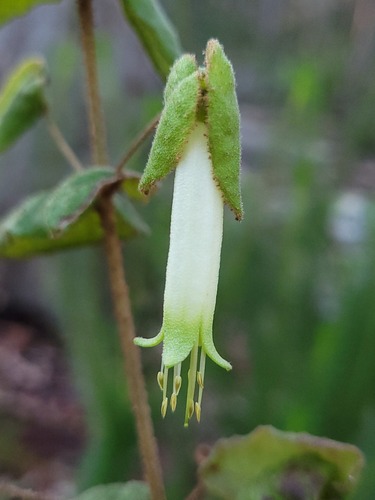
Photo by: eamonn_c, 2022, https://www.inaturalist.org/taxa/321098-Correa-reflexa, iNaturalist
Birdlife
Peter Gower, in Fleurieu Birds p. 249 indicates spotting 58 birds within Kyeema Conservation Park. This represents 25% of all birds listed in Fleurieu Birds:
- Australian Wood Duck | Chenonetta jubata
- Hardhead | Aythya (Nyroca) australis
- Australasian Grebe | Tachybaptus novaehollandiae
- Little Pied Cormorant | Phalacrocorax melanoleucos
- Australian Pelican | Plecanus conspicillatus
- White-faced Heron | Egretta novaehollandiae
- Straw-necked Ibis | Threskiornis spinicollis
- Brown Goshawk | Accipiter fasciatus
- Wedge-tailed eagle | Aquila audax
- Nankeen Kestrel | Falco cenchroides
- Brown Falcon | Falco berigora
- Australian Hobby | Falco longipennis
- Dusky Moorhen | Gallinula tenebrosa
- Common Bronzewing | Phaps chalcoptera
- Brush Bronzewing | Phaps elegans
- Crested Pigeon | Ocyphaps lophotes
- Yellow-tailed Black Cockatoo | Calyptorhynchus funereus
- Galah | Eolophus roseicapilla
- Sulphur-crested Cockatoo | Cacatua (Cacatua) galerita
- Rainbow Lorikeet | Trichoglossus haematodus
- Adelaide Rosella | Platycercus eximius
- Elegant Parrot | Neophema elegens
- Horsefield’s Bronze-Cuckoo | Chryscoccyx basalis
- Fan-tailed Cuckoo | Cacomantis flabellifornis
- Laughing Kookaburra | Dacelo novaeguineae
- White-throated Treecreeper | Cormobates leucophaeus
- Superb Fairy-wren | Malurus cyaneus
- White-browed Scrubwren | Sericornus frontalis
- Weebill | Smicrormis brevirostris
- Striated Thornbill | Acanthiza lineata
- Brown Thornbill | Acanthiza pusilla
- Yellow-rumped Thornbill | Acanthiza chrysorrhoa
- Buff-rumped Thornbill | Acanthiza reguloides
- Striated pardalote | Pardolotus striatus
- Eastern Spinebill | Acanthorhynchus tenuirostris
- Yellow-faced Honeyeater | Lichenostomus chrysops
- White-plumed Honeyeater | Phylidonyris penicillatus
- Little Wattlebird | Anthochaera lunulata
- Red Wattlebird | Anthochaera corunculata
- Crescent Honeyeater Phylidonyris pyrrhoptera
- New Holland Honeyeater | Phylidonyris novaehollandiae
- Brown-headed Honeyeater | Melithreptus brevirostris
- White-naped Honeyeater | Melithreptus lunatus
- White-fronted Chat | Epthianura albifrons
- Black-faced Cuckoo-shrike | Coracina novaehollandiae
- Golden Whistler | Pachyephala pectoralis
- Rufous Whistler | Pachyephala rufiventris
- Grey Shrike-thrush | Colluricincla harmonica
- Australian Magpie | Gymnorhina tibicen
- Grey Currawong | Strepera versicolor
- Grey Fantail | Rhipidura albiscapa
- Willie Wagtail | Rhipidura leucophrys
- Little Raven | Corvus mellori
- Magpie-lark | Grillina cyanoleuca
- Scarlet Robin | Petroica boodang
- Australian Reed-Warbler | Acrocephalus australis
- Silvereye | Zosterops lateralis
- Welcome Swallow | Hirundo neoxena
- Tree Martin | Hirundo nigracans
- Common Blackbird | Turdus merula
- Common Starling | Sterns vulgaris
- Mistletoebird | Dicaeum hirundinaceum
- Zebra Finch | Taeniopygia guttata
- Red-browed Finch | Neochmia temporalis
- European Goldfinch | Stagonopleura guttata
- European Greenfinch | Carduelis chloris
European History
The area was mined for alluvial gold for several years until it was abandoned in 1890 due to low yield. A few years later some of the area was cleared for pine plantations before being used as a labour prison reserve. This area at the western end of the park, once known as the Kyeema Prison Camp, was established in 1932. The camp was intended for well-behaved prisoners from Yatala, it held around thirteen prisoners and only two guards, with the prisoners were placed on their honour to behave. The Kyeema Prison Camp closed in the mid 1950’s and today there is only a cleared area of land visible to remind us of the Prison Camp’s existence.
National Parks and Wildlife Service (SA) | Kyeema Conservation Park
References
- Government of South Australia 2025, Bob Tiers Land System, viewed on 30 January, 2026, <https://data.environment.sa.gov.au/Content/Land-System-reports/BOT.pdf>. This PDF discusses the soils within a discontinuous belt of low hills and hills between Kuitpo and Yankalilla.
- Government of South Australia: Department of the Environment and Water 2023, BDBSA SuperTables – Overview, viewed on 28 August, 2026, <https://data.environment.sa.gov.au/Content/Publications/bdbsa-supertable-overview-fact.pdf>. This 3 page PDF provides an overview of the Biological Databases of South Australia super tables.
- Government of South Australia: Department of the Environment and Water 2023, Biological Databases of South Australia – Overview, viewed on 28 August, 2026, <https://data.environment.sa.gov.au/Content/Publications/bdbsa-overview-fact.pdf>. This 3 page PDF provides an overview of the Biological Databases of South Australia.
- Government of South Australia: Department of the Environment and Water 2026, BDBSA SuperTables – Field Definitions, viewed on 28 August, 2026, <https://data.environment.sa.gov.au/Content/Publications/bdbsa-supertable-field-definitions-fact.pdf>. This 7 page PDF contains a list of descriptions of Biological Databases of South Australia super tables
- Gower, P. 2012, Fleurieu Birds: What to see and where to see them, Axiom Australia, Stepney (Adelaide)