
Last updated on August 30th, 2026 at 05:57 pm
Research
The Pink Gum woodland appears in south eastern Australia including in the Fleurieu peninsula of South Australia. The tree storey is dominated by Eucalyptus fasciculosa, commonly known as Pink Gum.
Factsheets on the Pink Gum woodland communities
Prior to 2025, the Department of the Environment and Water (DEW), produced two factsheets:
- A short plant list for home and commercial use. The list groups plants into woodland canopy: trees and tall shrubs; and types of understorey: medium and small shrubs, sedges and rushes, grasses, herbs, ground cover, and climbers. Many of the plants could be grown from seed and most were available in state, council, commercial and not-for-profit nurseries.
- A complete plant list contains a full inventory of plant species which matched Pink Gum woodlands.
The plant lists blended plants from two Pink Gum woodland communities which share similar vegetation.
Trees
- Acacia pycnantha | Golden Wattle
- Allocasuarina verticillata | Drooping Sheoak
- Banksia marginata | Silver Banksia
- Callitris gracilis | Southern Cypress Pine
- Eucalyptus fasciculosa | Pink Gum
- Eucalyptus leucoxylon ssp. leucoxylon | South Australian Blue Gum
- Exocarpos cupressiformis | Native Cherry
shrubs
- Acacia myrtifolia | Narrow-Leaf Myrtle Wattle
- Acacia paradoxa | Kangaroo Thorn
- Acacia rupicola | Rock Wattle
- Allocasuarina muelleriana ssp. muelleriana | Common Oak-Bush
- Bursaria spinosa | Bursaria
- Calytrix tetragona | Common Fringe-Myrtle
- Daviesia brevifolia | Leafless Bitter-Pea
- Daviesia ulicifolia | Prickly Bitter-Pea
- Dillwynia hispida | Red Parrot-Pea
- Dodonaea viscosa ssp. spatulata | Sticky Hop-Bush
- Eutaxia microphylla | Common Eutaxia
- Grevillea lavandulacea ssp. lavandulacea | Lavender Grevillea
- Hakea carinata | Erect Hakea
- Hakea rostrata | Beaked Hakea
- Hibbertia exutiacies | Prickly Guinea-Flower
- Hibbertia riparia | Bristly Guinea-Flower
- Leptospermum myrsinoides | Heath Tea-Tree
- Olearia ramulosa | Twiggy Daisy-Bush
- Pimelea stricta | Erect Riceflower
- Platylobium obtusangulum | Holly Flat-Pea
- Pultenaea largiflorens | Twiggy Bush-Pea
- Pultenaea pedunculata | Matted Bush-Pea
- Xanthorrhoea semiplana ssp. semiplana | Yacca
Sedges and rushes
- Lomandra micrantha | Small-Flower Mat-Rush
- Lomandra multiflora ssp. dura | Hard Mat-Rush
- Lomandra nana | Small Mat-Rush
Grasses
- Austrostipa nodosa | Tall Spear-Grass
- Themeda triandra | Kangaroo Grass
herbs
- Arthropodium strictum | Common Vanilla-Lily
- Bulbine bulbosa | Bulbine-Lily
- Chrysocephalum apiculatum | Common Everlasting
- Daucus glochidiatus | Native Carrot
- Dianella revoluta var. revoluta | Black-Anther Flax-Lily
- Geranium retrorsum | Grassland Geranium
- Glycine rubiginosa | Twining Glycine
- Goodenia blackiana | Native Primrose
- Helichrysum scorpioides | Button Everlasting
- Lagenophora huegelii | Coarse Bottle-Daisy
- Leptorhynchos squamatus ssp. squamatus | Scaly Buttons
- Lobelia gibbosa | Tall Lobelia
- Ptilotus spathulatus f. spathulatus | Pussy-Tails
- Thysanotus patersonii | Twining Fringe-Lily
- Tricoryne elatior | Yellow Rush-Lily
- Wahlenbergia stricta ssp. stricta | Tall Bluebell
Groundcover
- Convolvulus erubescens | Australian Bindweed
- Dichondra repens | Kidney Weed
- Kennedia prostrata | Scarlet Runner
- Kunzea pomifera | Muntries
- Scaevola albida | Pale Fanflower
Pre-European Distribution of Pink Gum woodlands
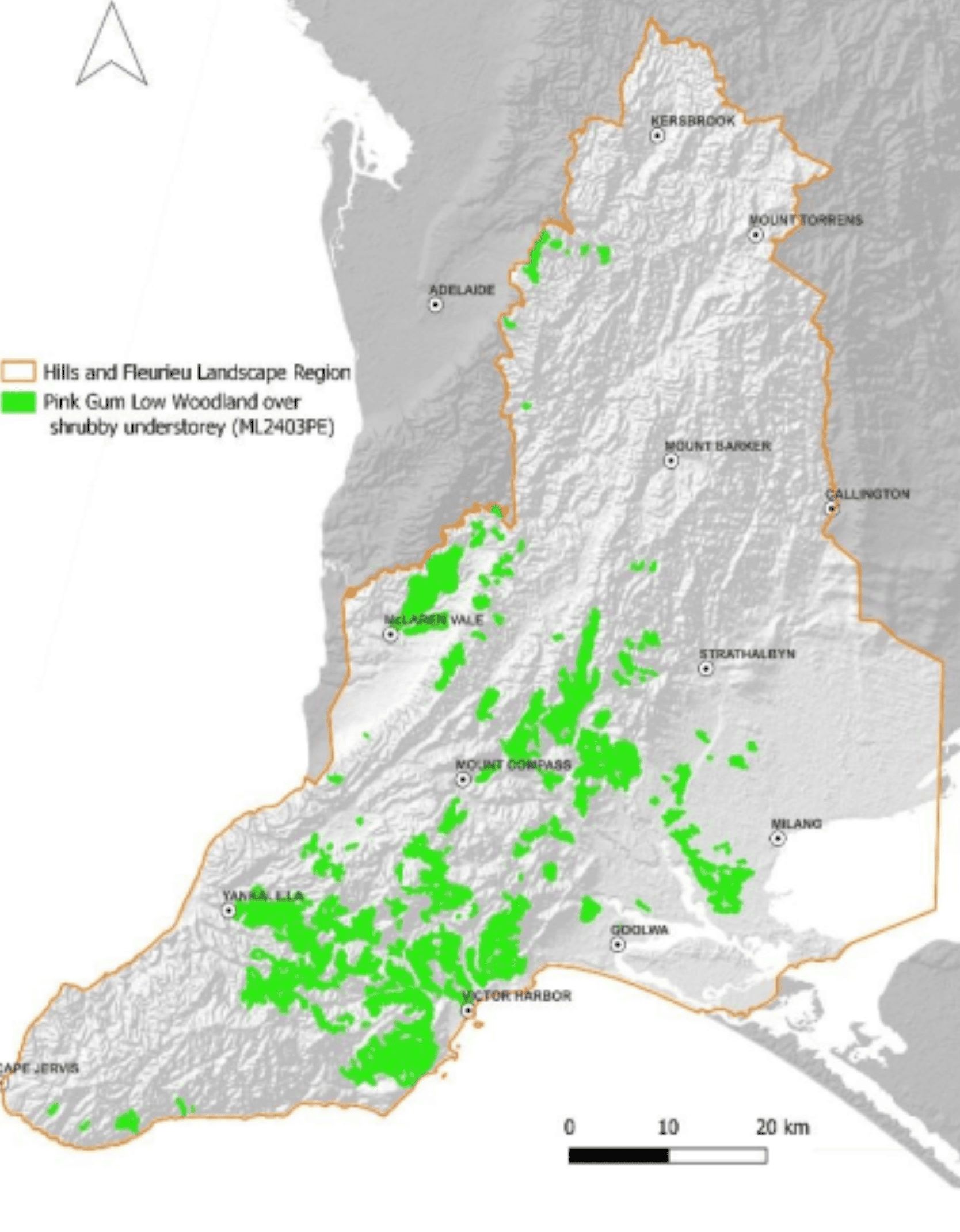
The distribution of both woodlands before European settlement in the graphics below (marked in green) shows the extent of each woodland. The location of the woodlands correspond in general to Permian sand deposits left behind millions of years ago.
Finding the woodlands in your area of the Fleurieu
DEW had developed NatureMaps, an online mapping tool for identifying the Pre-European vegetation plant communities throughout South Australia. Each of the woodlands were defined by NatureMap vegetation codes. In the case of the Pink Gum woodlands, there was a key: ML2403PE . This factsheet remains available online at the Green Adelaide web site.
In 2025, the Landscape Board, Hills and Fleurieu, published a factsheet for the Pink Gum vegetation profile with a reference to the vegetation code:
Each factsheet distinguishes clearly the plants in these distinct communities. They are a great deal more detailed; each providing information about:
- Community distribution in the Fleurieu in map format (See maps)
- Soil type, rainfall, and notes on revegetation
- A plant list separated into plant type: trees, shrubs, mat plants, sedges and tussocks, twiner/scramblers, and herbs
- Details for each plant including: whether plants can be purchased in a plant nursery, propagation methods, seed treatment, and seed propagation treatments, and level of difficulty for seed propagation, and how the plants are pollinated.
Pre-European Plant communities in Mount compass area
There are a number of Pink Gum woodland communities in the Mount Compass area. They are often associated with good quality soils, making good farmland.
Nangkita Pink gum woodland
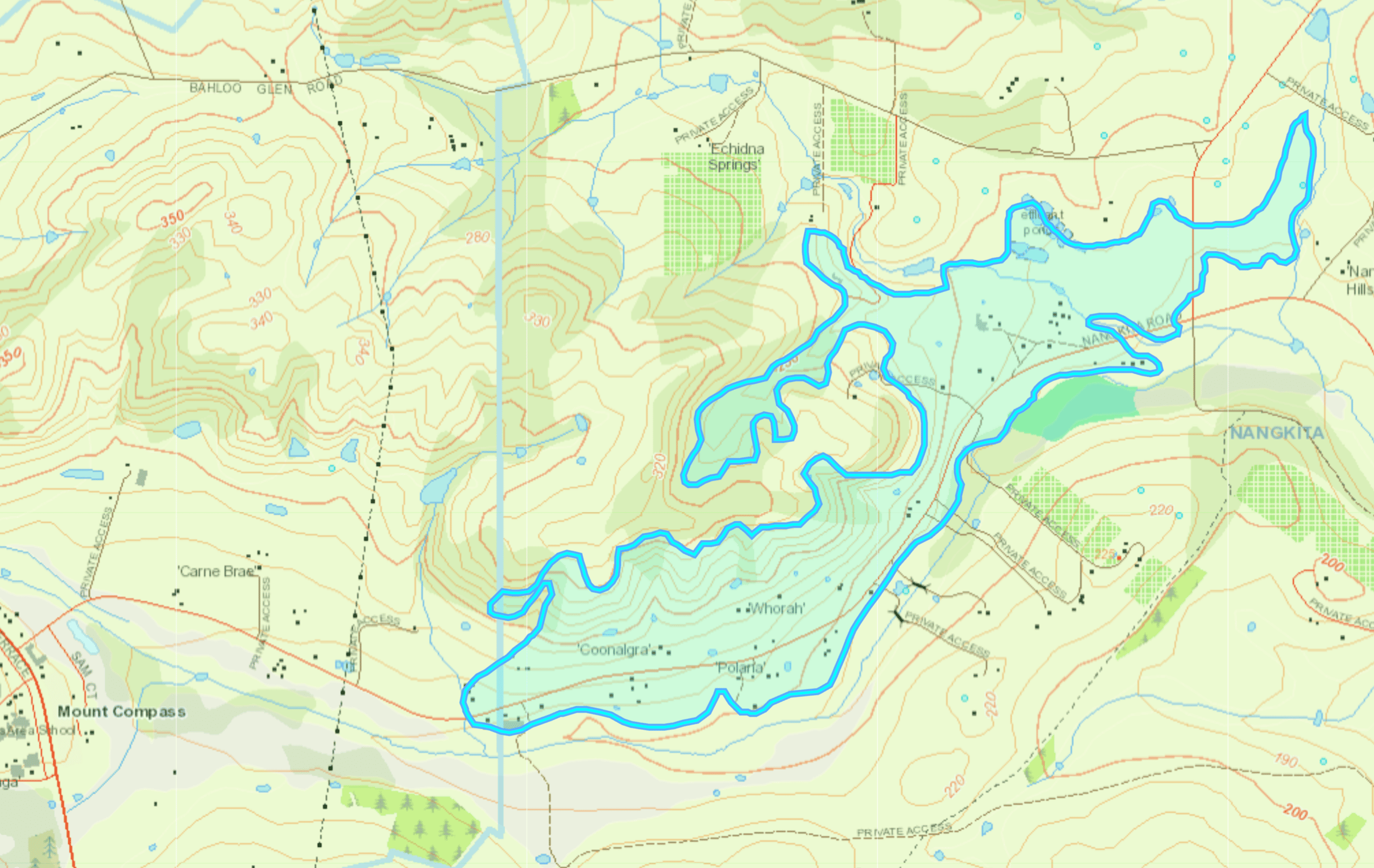
The woodland rises above the Nangkita wetland running along Nangkita road east of Mount Compass.
woodcone road Pink gum woodland

The pink gum woodland rises above the Tookayerta tributary, running along Woodcone road south of Mount Compass west of Victor Harbor road.
European Settlement
Much of the Pink Gum woodlands yielded to dairy and meat production. The application of fertiliser and irrigation maintained production throughout the year. Pine plantations replaced woodlands as a source of timber and wind breaks. Pine trees do well in well-drained soils.
Distribution today
The PInk Gum woodland (ML2403PE) is a fraction of its original pre-European distribution, approximately 13.8% remaining.
Of the approximately 26,000 hectares (ha) mapped as being present prior to European settlement, approximately 3,600 ha have been mapped in the Department of Environment and Water’s extant mapping layer (Data SA 2025).
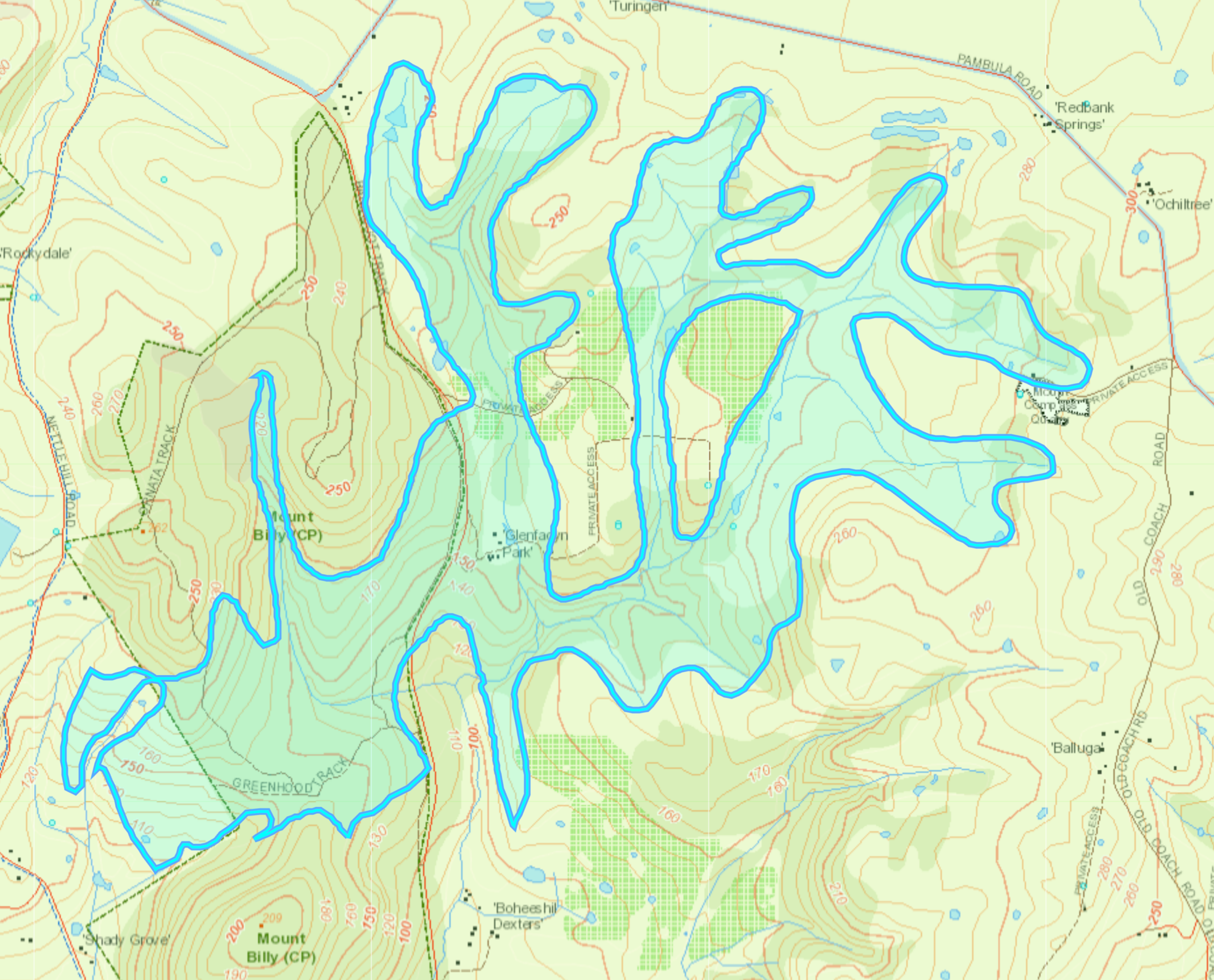
To preserve these woodland ecosystems, the Department of Environment and Water has set aside conservation parks. According to NatureMaps, Pink Gum woodland occupies some of Mount Billy conservation park.
The graphic below shows the area within Mount Billy conservation park occupied by Pink Gum woodland.
Threat of habitat loss
The Landscape Board, Hills and Fleurieu (Landscape HF) is actively pursuing revegetation of areas to support the wildlife unique to Stringybark woodlands. Many of understorey plants can be grown from seed or seedlings or purchased from a Native nursery for private and public spaces. LIfestyle blocks and farms can plant canopy trees and understorey to support birds, bees and other native wildlife associated with Brown Stringybark woodlands.
References
- Croft, S, Croft, T 2026, Vegetation Community Profile, Pink gum (Eucalyptus fasciculosa) Low Woodland over shrubby understorey(ML2403PE), viewed on 14 August, 2026, https://hf.landscape.sa.gov.au/media/plant-species/ML2403PE-Pink-gum-Low-Woodland-over-shrubby-understorey.pdf. This 7 page PDF factsheet provides details about the Pink Gum vegetation community.
- Government of South Australia 2026, NatureMaps: Welcome to NatureMaps, viewed on 8 August, 2026, <https://data.environment.sa.gov.au/naturemaps/Pages/default.aspx>. This is the official website of Enviro Data SA, a service of the department of the environment, South Australia.
- Government of South Australia 2023, Pink Gum (Eucalyptus fasciculosa) Woodland, viewed on 16 February, 2024, https://cdn.environment.sa.gov.au/landscape/docs/hf/b4w-species-list-h24-fact.pdf. This 2 page PDF provides a list of the plant species associated with the Pink Gum woodland.
- Nicolle, D. 2026, Eucalypts of South Australia 2nd Edition, Dean Nicolle.


